

The small business owner’s money problem
The reality for most small business owners isn’t a lack of great business ideas; it’s a structural barrier to growth. Many entrepreneurs start small, maybe even from their small home office or garage, and successfully validate their concept. But scaling requires capital. You might need R50,000 for a new batch of stock, or R20,000 for targeted ads, but your profit from last month is still tied up in receivables or waiting to clear through traditional systems.
This need is not a lack of profit; it’s a need for liquidity. This is the heart of the working capital problem. Without flexible working capital for your business, even the best-laid small business plan can stall. This is especially true for entrepreneurs and small businesses still working through the challenges of business registration and understanding VAT obligations. These are formal processes that take time and focus away from making sales.
- Understanding liquidity: Many SMEs fail not because they aren’t profitable, but because they can’t cover short-term debts.
- The long-term view: Access to quick capital allows you to pivot from thinking about just survival to focusing on long-term business development.
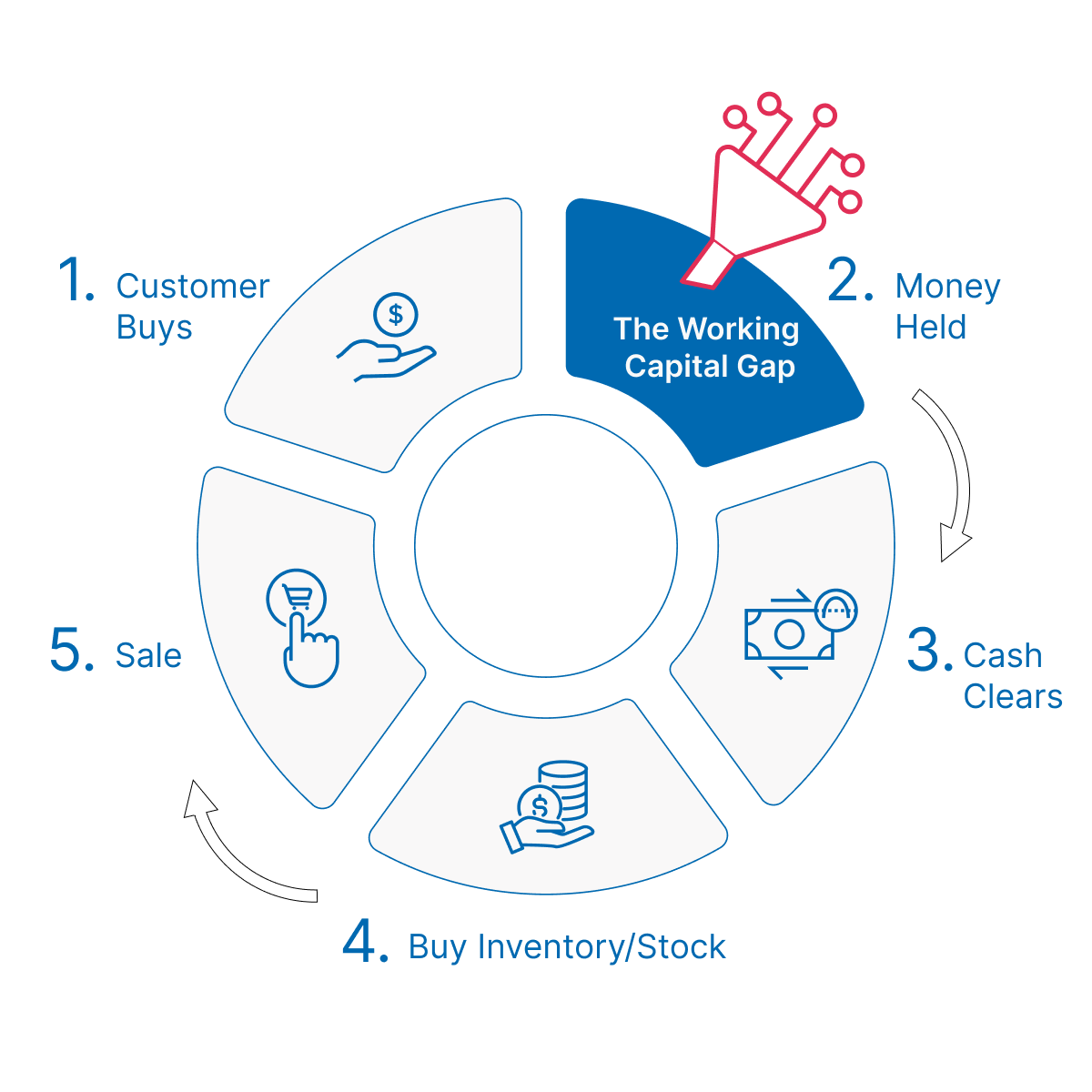
The core challenge for many SMEs is liquidity, not profitability, which creates an urgent demand for working capital.
The rise of flexible merchant funding
When speed is the priority, waiting for traditional business lending isn’t an option. This is why merchant funding, and specifically the merchant cash advance, has become a popular solution for small business funding in South Africa.
What is a merchant cash advance?
A merchant cash advance is business funding specifically designed for businesses that use either a POS device, ecommerce platforms, or both, to receive payments. Simply put, it’s a type of business funding in which the funder is paid by taking a percentage of the businesses’ revenues or sale proceeds. This means you only pay back when you make money. This flexible approach makes it a practical form of small business cash advance.
The biggest draw here is how it differs from a loan. With a bank loan, you have a fixed monthly payment regardless of how your business performed that month. If sales are slow, you’re stressed. A merchant capital advance, however, adjusts automatically. If you have a slow week, your repayment is smaller; if you have a massive surge in sales, you repay faster.
This flexibility is essential for ecommerce businesses that see seasonal peaks and troughs, or for start- up businesses whose revenue is inherently unpredictable as they find their feet.
What is the difference between a loan and a merchant cash advance?
Business lending usually means fixed repayments due on a set schedule. But when you take a merchant cash advance, you repay that money as a percentage of your sales, so you only pay more when your business earns more.
A merchant cash advance offers a flexible repayment model linked to daily sales, which is a key advantage over fixed-term business lending.
Eligibility and cost: What to expect from a merchant cash advance
While a merchant cash advance is easier to access than a bank loan, it’s not free cash. To qualify for a service like Payfast’s Easy Advance, a partnership with TymeBank, providers will typically look for a few key metrics that confirm your business stability.
The core eligibility requirements usually include:
- Minimum sales volume: Your monthly sales must meet a defined minimum threshold over a certain amount of time. This ensures the provider can accurately assess the size of the cash advance that business owners can afford.
- Consistent trading history: You must have been trading and accepting payments through the relevant platform for a minimum period (e.g., 6–12 months).
Crucially, merchant funding doesn’t charge traditional interest. Instead, a flat fee (the factor rate) is applied to the initial advance amount upfront. This fixed cost structure helps SMEs budget effectively, making it a highly transparent form of working capital compared to variable interest loans.
What exactly is a factor rate?
This is an important question as the factor rate is the single most defining cost associated with a merchant cash advance. Unlike a loan where you pay variable interest that accrues over time, an advance uses a fixed rate. This means the fee is calculated once, upfront and doesn’t change regardless of how long it takes you to repay.
The factor rate is usually expressed as a decimal, typically ranging from 1.15 to 1.4.
Let’s look at it simply:
- Say your business receives working capital of R50,000.
- Your total repayment is R50,000 x 1.25 = R62,500.
- The provider offers a factor rate of 1.25.
That R12,500 difference is the total, fixed cost for accessing the cash advance for business owners. For an SME needing to budget, this fixed structure is often much easier to manage than fluctuating interest rates. You know the final cost from day one, which is a significant benefit.
Eligibility for a merchant cash advance hinges on a consistent trading history and minimum sales volume. The cost is structured as a transparent, fixed factor rate instead of variable interest.
Easy Advance: A solution tailored for growth
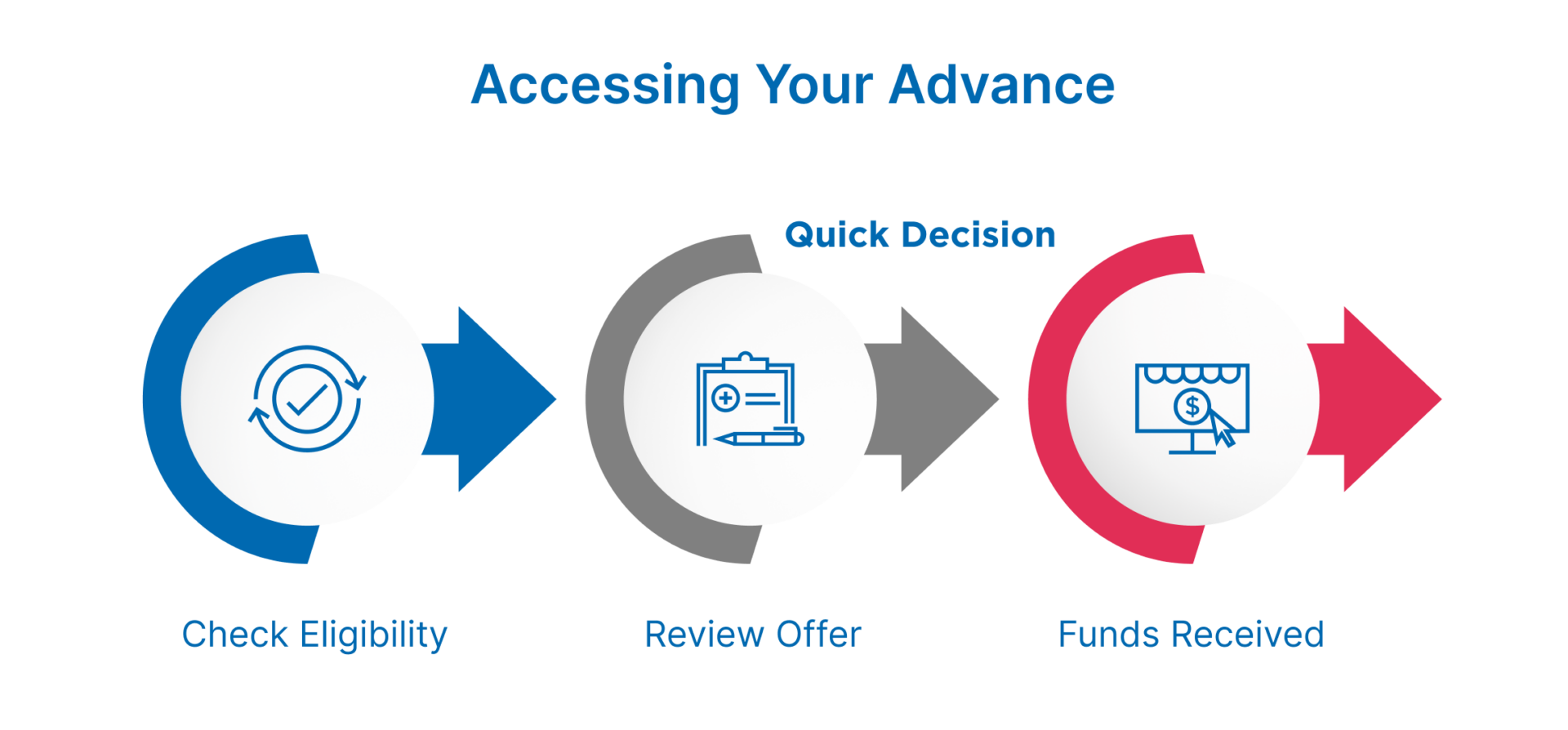
Many small business owners who process payments through platforms like Payfast by Network already have the key to quick funding: their own sales history. A service like Easy Advance leverages this verifiable transactional data to make rapid funding decisions.
When seeking working capital, you typically look for three things: speed, simplicity, and a trusted partner.
- Simplicity: The application process is streamlined because the provider already has access to your sales performance data. There are no lengthy board meetings or complex collateral requirements. If you qualify, you get a notification on your dashboard.
- Trust: Using a system you already trust, like Payfast by Network, to access a cash advance means dealing with one provider instead of introducing a new third party. This can greatly simplify your financial management and avoid confusion around small business tax.
- Speed: Funds are transferred within 24 hours, not weeks or months. This means you can use the cash advance for business owners to purchase stock or invest in business development within a short period of time.
This kind of partnership reflects the principle of Payfast Always Open, a commitment to keeping your business running and ready to act on opportunities, even when traditional finance is closed off.
Easy Advance uses existing sales data to provide a rapid, simple
,and trusted source of merchant funding.
Beyond the cash advance: Strategic planning for SME
While a small business cash advance can solve immediate problems, long-term success requires strategic planning that encompasses more than just access to cash. If you are operating a small office, you should always be thinking about formalisation and efficiency.
For instance, understanding small business tax and when to register for VAT (which usually requires VAT registration for small business) are key components of growth, not just compliance. Before starting formal processes, pick a strong, memorable small business name idea and map out a simple small business plan.
You can also look into support from government or industry bodies. For example, the National Empowerment Fund (NEF) in South Africa provides capital for business development and funding for B-BBEE focused start-up businesses. It’s always worth seeing what formal resources are available, even if they take longer. Securing a diversified funding approach is smart business development.
For information on South African small business support programmes, you can also consult the official website of the Small Enterprise Development Agency (SEDA) for verified information on resources and mentorship.
Focusing on the fundamentals, even the boring ones like compliance, gives you a stronger base. It means that when you take on working capital you can spend less time worrying about administration.
Sustainable growth for SMEs requires balancing quick merchant funding with long-term strategic planning, formalisation and compliance.
Making your cash flow work as hard as you do
The modern landscape for local businesses demands agility, and that means being able to access money when and where you need it. By using a solution like a merchant cash advance based on your verified sales, you decouple your growth from the slow processes of traditional business lending.
You now know that a need for working capital isn’t a failure, it’s a sign of growth potential waiting to be unlocked. If you’re brainstorming little business ideas or managing a larger business, securing the right business funding partner is the key to maintaining control.
Ready to see how fast your sales can turn into readily available working capital?
Explore Easy Advance today and see how easy small business funding in South Africa can be.