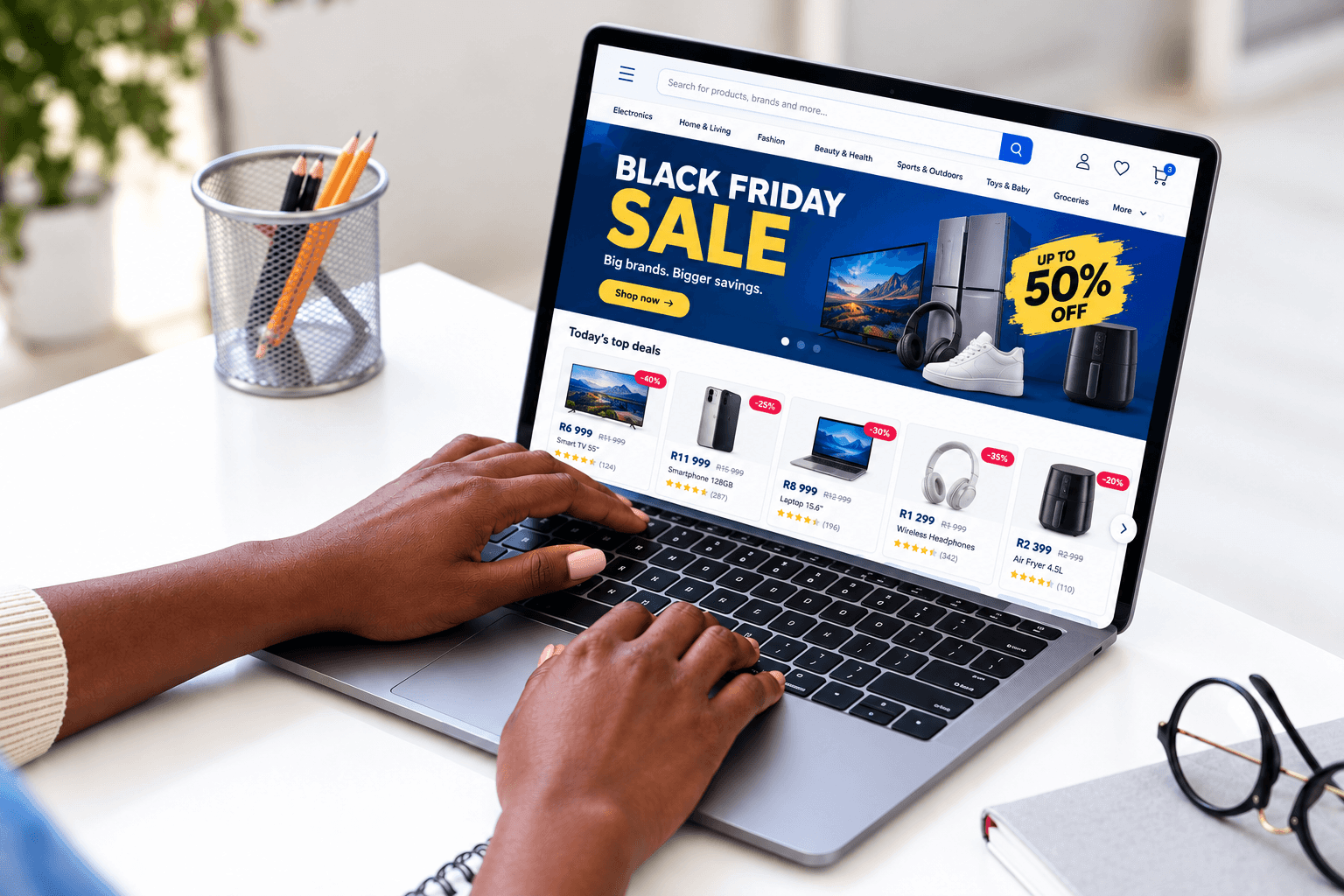
Black Friday and the festive season give South African SMEs a valuable opportunity to drive sales, but a good deal doesn’t always have to mean a big discount.
Cutting prices across your entire store can quickly eat into margins. A more considered promotion can give customers a reason to buy while helping you increase basket size, move selected stock and make the most of the seasonal shopping period.
The trick is getting the offer right. Here are a few practical ways to build Black Friday and festive season promotions that deliver value for your customers and make commercial sense for your business.
Start with the goal, not the discount
Before deciding that everything will be 20% off, think about what you actually want your promotion to achieve.
Are you trying to attract new customers? Increase the value of each order? Move particular products? Reward loyal shoppers? Or perhaps encourage customers to buy earlier in the festive season?
Your goal should determine the deal. For example, if increasing average order value is the priority, a minimum-spend offer such as “Spend R750 and save R100” could be more useful than applying a discount to every product.
If you have complementary products, a bundle might make more sense. And if you want customers to return in December after shopping on Black Friday, an offer linked to their next purchase could help extend the value of the campaign.
This way, you’re not discounting simply because everyone else is.
Bundle products to create more value
Bundles can make a deal feel worthwhile without requiring a large price reduction on individual items. The simplest approach is to group products customers are likely to buy together.
For example:
- A skincare business could create a festive gift set.
- A coffee merchant could combine beans, a mug and another accessory.
- A clothing store could bundle complementary items at a special price.
- A food business could create a seasonal hamper.
You can also use multi-buy offers such as “3 for R250” or “Buy two and save 15%”.
Good bundles have one thing in common: they make sense to the customer. Combining unrelated products simply to clear stock can weaken the appeal of the offer.
Choose discounts that customers understand immediately
During Black Friday, customers are scrolling through emails, social posts and online stores filled with competing promotions. Don’t make them work to understand yours.
“20% off selected products” is straightforward.
So is “Save R150 when you spend R750.”
Complex conditions and multiple exclusions can make an otherwise attractive promotion harder to understand.
The type of discount matters too. A percentage saving may feel compelling on a higher-priced purchase, while a clear rand saving shows customers exactly how much they’ll keep in their pocket.
Whichever approach you choose, make sure your margins can support it before your campaign goes live.
Use spend thresholds to grow basket value
You don’t necessarily need to discount the products themselves. A minimum-spend incentive gives customers another reason to add something extra to their basket.
You could offer:
- Free delivery when spending over a set amount
- A free gift above a certain order value
- A discount once customers reach a minimum spend
- An additional saving when buying multiple products
The important part is setting the threshold carefully. Look at what customers usually spend with you and choose a target that encourages them to add to their basket without feeling out of reach. If your typical order is around R500, for example, an incentive at R550 or R600 may feel more attainable than one that only kicks in at R1,000.
Give loyal customers something extra
Not every promotion needs to be available to everyone at the same time. Your existing customers and subscribers are already familiar with your business, making peak season a good opportunity to reward that relationship.
Consider giving them:
- Early access to Black Friday offers
- Subscriber-only deals
- An additional saving on selected products
- First access to limited stock
- A festive voucher towards their next purchase
It can also help you spread demand instead of concentrating every order into a single trading day.
Create urgency without overcomplicating the offer
There’s a reason flash sales are so common around Black Friday. A genuine deadline gives customers a reason to make a decision.
A deal could run for a few hours, a day or until available promotional stock has sold. But urgency works best when it’s real. Be clear about when an offer starts and ends, which products qualify and any conditions attached to it. Clear promotional terms build trust and reduce the chances of disappointed customers discovering an exclusion when they’re ready to pay.
Think beyond Black Friday
Black Friday may be the big promotional date on the calendar, but the opportunity doesn’t stop there. Customer priorities change as December approaches. Early festive shoppers may be looking for a bargain, while later shoppers could place greater value on gifting, availability and convenient delivery. That gives SMEs an opportunity to change the offer instead of running the same sale for weeks.
For example, your peak-season campaign could move through:
- Black Friday: A strong price-led promotion on selected products.
- Early December: Gift bundles and curated product sets.
- Mid-December: Free-delivery thresholds or gifting incentives.
- Late December: Offers on selected seasonal stock.
The result is a reason to keep communicating with customers without repeatedly offering the same discount.
Make it easy for customers to complete the purchase
Once you’ve caught someone’s attention with the right deal, the last thing you want is unnecessary friction when they’re ready to pay. Keep the purchase journey straightforward and make sure customers can easily see the final price, delivery costs and payment options available to them.
Payfast by Network gives merchants access to 20+ payment methods, helping customers choose the way they prefer to pay. Options include cards, Instant EFT and open banking payment methods such as Capitec Pay and Absa Pay, mobile wallets including Apple Pay, Google Pay and Samsung Pay, Buy Now, Pay Later options such as Payflex, and QR code payment options like SnapScan and Zapper.
This flexibility can be particularly useful when the value of purchases varies. A customer buying a smaller stocking filler may want to pay differently from someone purchasing a higher-value festive gift.
For SMEs selling both online and in person, Payfast POS can also support payments at physical stores, markets and pop-ups. If you’re planning in-person festive trading, read our guide to choosing the right card machine for peak retail sales for more practical advice.
Check the numbers before you launch
A promotion needs to work for your business as well as your customer.
Before publishing a deal, sense-check:
- Your margin after the discount
- Product and packaging costs
- Delivery or courier costs
- The effect of any free gifts
- Stock available for the promotion
- The minimum order value needed for the offer to make sense
Once the promotion is running, keep an eye on what’s selling. A bundle that looks good on paper isn’t necessarily the one customers will choose. If one offer is performing particularly well and another isn’t gaining traction, use those insights to guide your next promotion.
Make your festive season offers work harder
A competitive festive season deal doesn’t have to be the deepest discount. A well-structured bundle, smart spending threshold or simple multi-buy promotion can give customers clear value while helping you protect your margins and work towards a specific business goal.
And your offer is only one part of getting ready for the busiest shopping period of the year. For a broader look at stock, ecommerce, marketing, payments, fulfilment and fraud prevention, read Payfast’s Black Friday and festive season preparation checklist.
With the right offer and a smooth way to pay, you’ll be better placed to turn festive season interest into sales.